
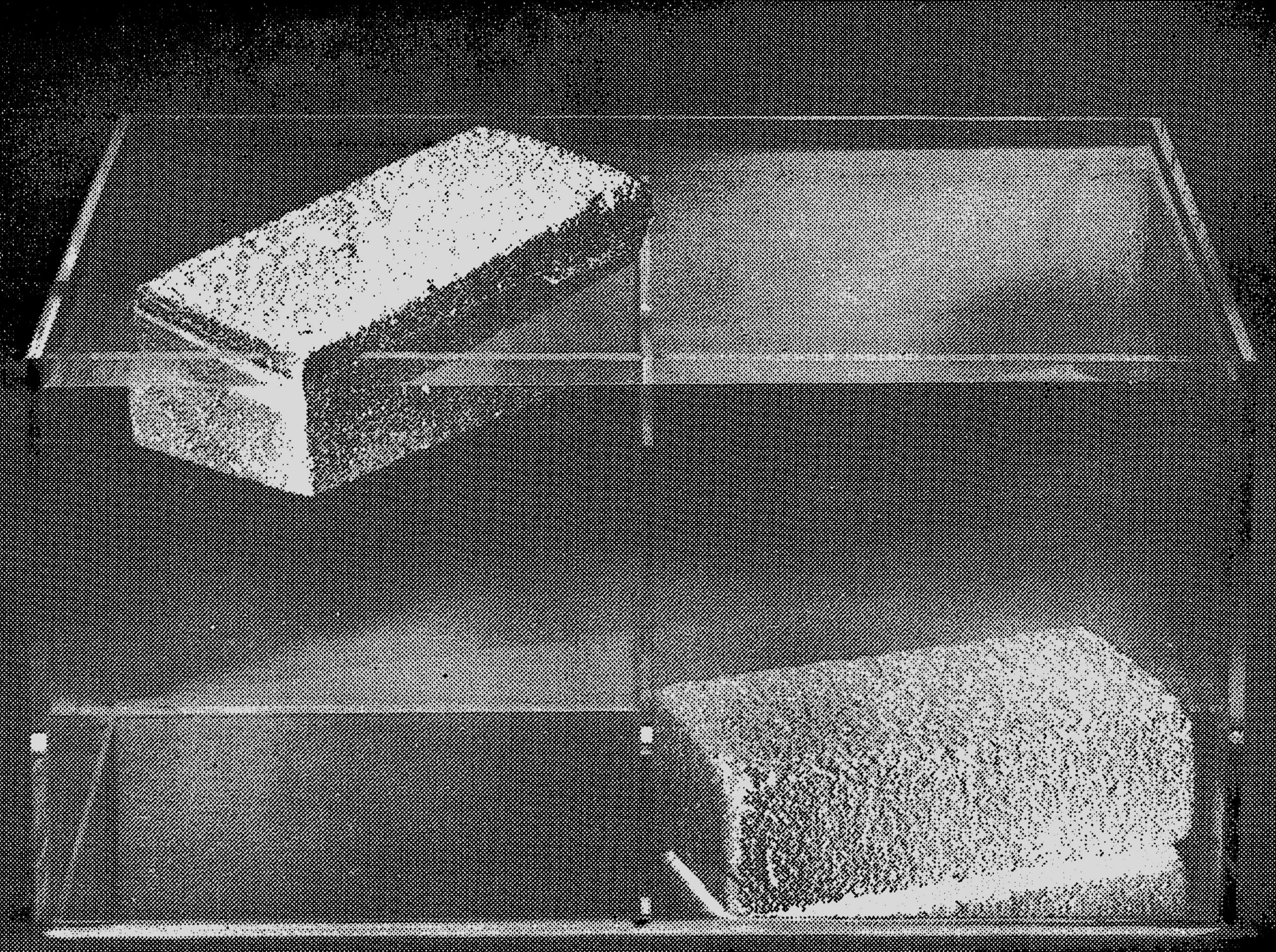
Burden of Proof. 2026. Image courtesy of the artist.
Burden of Proof
September 3rd - October 17th, 2026
Opening Reception: First Thursday, September 3, 5-8PM
Second Reception: First Thursday, October 1, 5-8PM
Gallery Hours: By Appointment on Saturdays, 12-3PM
Specialist presents Burden of Proof, new work by Tania Colette B.
Within networks of financialization, growth is the baseline condition of all things. Under this structure, an object must be unstable to survive: a house must transform from an object for sheltering to an object for capital production in order to not be demolished. Burden of Proof is a new series of sculpture and installation-based works exploring fragmentation, interruption, containment, and breach as mechanisms for apprehending this precarious condition. Using a range of found, made, and transformed objects – some domestic and familiar, others more elusive or abstract – the exhibition looks to break things down to their component parts, seeking order in the remains. Still, it undermines itself at every turn: if an object’s life is one of constant recalibrations, so is everything else’s.
Tania Colette B. is an artist based in Seattle. Her work explores the sculptural byproducts of finance capitalism, speculation, and state power. With sculpture, installation, found media, and repurposed building materials, she re-stages sites of social resistance, economic failure, and environmental exploitation in order to examine them from a material vantage point. She holds an MA in Culture Industry from Goldsmiths, University of London (2020) and a BFA in Sculpture from California College of the Arts (2014). She is a member of SOIL and Specialist in Seattle.
In 2017, I stumbled upon a housing development in the outskirts of Isleton, California, a tiny town located on the Sacramento River with a population of about 800. I spotted the unusual formation from the road: a cluster of houses, set closely side-by-side as if huddled for warmth, situated in a perfect bull’s-eye at the center of a barren, brown grass field. After pulling in for a closer look, I found that the field was in fact not empty, but dotted with exposed electrical tubing upon which new homes had never been constructed. The single road which cut through the development was paved and sidewalked, with ADA-compliant yellow tactile pavers and curb ramps at the only intersection. Also at the intersection was a solitary wooden road sign which read BERNADETTE PL. in hand-painted white block letters.
The overall scale of the place was uncanny: the houses were somehow both too big and too small, the road too wide, the field too dead, the walkways too pristine. There should have been a vast horizon, but it seemed to end before it began, sunk beneath the highway that divided it from the river. The place was finished, but there were no people; it was unfinished, but there were no bulldozers.
After I got out of my car to walk around, a young man, likely in his early twenties, emerged from one of the houses and introduced himself as the security guard on the premises. I learned over the course of our conversation that he lived onsite, keeping 24/7 watch over the property and also doubling as a real estate agent, of ering showings to any curious passersby. He explained that development of the property began in 2007, but that after the housing market crashed, construction halted indefinitely. He gestured a half mile down the road, pointing out a dozen or so completed homes which hugged the edge of the field. At the time of our conversation, only one of the homes had been sold, occupied by a single resident. He then led me on a tour of the house next to his, which he described quite accurately as being “of its time”: speckled granite countertops, cherry-wood cabinets, carpeted staircases, flush-mount lighting fixtures. I knew these textures well. I felt I had seen a thousand homes just like this one; the housing bubble had this effect.
The guard was always on the clock, perched upon the third floor of “his” residence with weapons and binoculars and a television, always at rest but always in motion, not unlike the space he occupied. He was in a position of constant appraisal, appointed to manage potential vandals side-by-side with potential buyers, to codeswitch between custodian and spokesperson at a moment’s notice. Most of all, he was stuck in many moments at once: in the pre-collapse construction rush, in the post-collapse recession, in the perpetual present of capitalist ruin. But he was also profoundly unstuck, precariously positioned as both occupant and employee of a house that was never his, and presumably being tasked with the mission of displacing himself, should a buyer ever come along. The “house-ness” of the house prompted certain behaviors: he slept and ate in the house, and kept his possessions there, and opened and closed the doors when it was time to say hello or goodbye. But the house was more perceivably a financial abstraction—a footnote in a likely-defaulted synthetic CDO—than it was a house. It was a sculpture of speculation, here made visible by its failure as an index of profit.
Material form lives a strange double life in this respect: in addition to its flattening by financial markets, it can also still fulfill the exterior purpose for which it was literally constructed. So then, when is a house a house, and when is it something else? What else is it sheltering? What else has found a home here?
Tania Colette B. Speculative Sculpture: An Inquiry into the Forms of Speculation, 2020.